
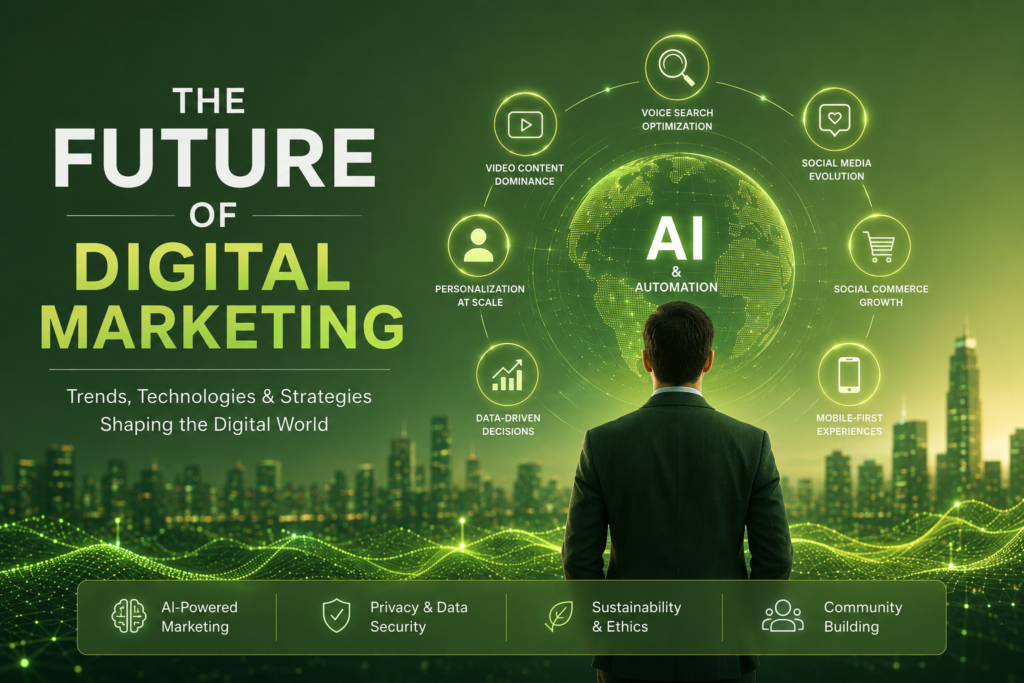
Digital marketing is evolving faster than ever. What once focused mainly on social media posts, website traffic, and online ads is now becoming more intelligent, personalized, community-driven, and technology-powered. As businesses compete for attention in an increasingly crowded online space, the future of digital marketing will be shaped by AI, automation, privacy-first strategies, immersive experiences, and Web3 technologies.
The brands that succeed in the coming years will not be the ones that simply market louder — they will be the ones that market smarter, build trust, create value, and adapt to how people interact online
What is the Future of Digital Marketing?
The future of digital marketing is all about creating better digital experiences. Instead of relying only on traditional ads or generic content, businesses will use advanced tools and data-driven strategies to deliver personalized, interactive, and meaningful communication.
Digital marketing is moving from:
- Mass promotion to personalized communication
- Cookie-based tracking to privacy-first marketing
- Static content to interactive and immersive experiences
- Platform-controlled audiences to community-owned engagement
- Manual execution to AI-assisted strategy and automation
In simple terms, the future of digital marketing is not just about being online — it is about being relevant, trusted, and customer-focused across every digital touchpoint.
Important Trends Influencing Digital Marketing's Future
- Artificial Intelligence Will Power Smarter Marketing
AI is already altering how marketers produce content, run advertisements, examine data, and enhance consumer experiences. In the future, AI will become an even more important part of digital marketing.
Businesses will use AI to:
Create content ideas and campaign drafts faster
Personalize emails, ads, and website experiences
Predict customer behavior and buying intent
Optimize ad campaigns in real time
Automate customer support through chatbots and assistants
However, AI will not replace marketers completely. Instead, it will make marketers more efficient by handling repetitive tasks while humans focus on strategy, creativity, storytelling, and brand building.
2. Personalization Will Become the Standard
Customers no longer want generic messages. They expect brands to understand their interests, needs, and behaviors. The future of digital marketing will focus heavily on hyper-personalization.
This means businesses will deliver:
- Personalized email campaigns
- Product recommendations based on user behavior
- Dynamic website content
- Targeted ad experiences
- Customized offers and messaging
The goal is to make every customer feel like the brand is speaking directly to them.
3. Privacy-First Marketing Will Be Essential
As data privacy becomes more important, marketers can no longer depend only on third-party cookies and aggressive tracking methods. Consumers want more transparency about how their data is collected and used.
Future digital marketing strategies will focus on:
First-party data collection
Permission-based email marketing
Transparent privacy policies
Ethical personalization
Trust-building communication
Brands that respect user privacy and build trust will have a major advantage in the long run.
4. Video and Short-Form Content Will Continue to Dominate
Video content is already one of the strongest digital marketing tools, and its role will only grow in the future. Short-form videos, educational reels, behind-the-scenes content, live sessions, and storytelling-based video marketing will become even more powerful.
Consumers want fast, engaging, and visual content. Brands that can educate, entertain, and connect through video will stand out in crowded digital spaces.
5. Search Will Change with AI and Conversational Discovery
Search is no longer just about keywords. More people now ask full questions in search engines and AI assistants. This means the future of SEO will focus less on keyword stuffing and more on helpful, conversational, high-quality content.
Brands will need to create content that:
Answers real user questions
Shows expertise and trustworthiness
Uses clear structure and strong content strategy
Is optimized for both search engines and AI-powered discovery tools
The future of SEO is not just ranking on Google — it is being discoverable wherever people search for answers.
The Rise of Web3 Digital Marketing
One of the most exciting developments in the future of digital marketing is Web3 digital marketing. Web3 represents a new version of the internet built around decentralization, blockchain technology, digital ownership, transparency, and community participation.
Unlike traditional digital marketing, where brands depend heavily on centralized platforms like Google, Meta, or Instagram, Web3 introduces a more community-led and user-owned digital environment
What is Web3 Digital Marketing?
Web3 digital marketing is the practice of promoting brands, products, services, or communities in decentralized digital ecosystems using blockchain-based tools, community platforms, token-based engagement, NFTs, DAOs, and wallet-driven experiences.
In Web2 marketing, users mostly consume content.
In Web3 marketing, users can participate, contribute, own, and influence the ecosystem.
This creates a major shift in how brands build relationships with audiences.
How Web3 Will Change Digital Marketing
- Community Will Become More Powerful Than Audience
In Web3, the focus is not just on gaining followers — it is on building active communities. Instead of simply broadcasting messages, brands will create spaces where users can interact, contribute, and feel like part of the brand’s growth.
This means future marketing will focus more on:
Community building on platforms like Discord and decentralized communities
Direct engagement with loyal users
Rewarding participation and contribution
Building stronger brand loyalty through belonging
- Ownership-Based Engagement Will Increase
Web3 introduces the idea of digital ownership through NFTs, tokens, and blockchain-based assets. This opens new possibilities for marketers to create loyalty programs, memberships, rewards, and exclusive brand experiences.
For example, brands may offer:
NFT-based access to exclusive communities or events
Token rewards for customer engagement
Digital collectibles tied to campaigns
Loyalty programs built around ownership and participation
This can make brand engagement more interactive and emotionally valuable.
- Transparency Will Build More Trust
Blockchain technology allows transactions and interactions to be more transparent. In digital marketing, this can improve trust by giving users greater visibility into offers, rewards, campaign participation, or ownership records.
As trust becomes one of the most valuable assets in digital marketing, Web3 can help brands create more open and verifiable experiences.
- Decentralized Identity Could Change Personalization
In the future, users might have greater authority over
their online identity and personal data. Instead of platforms owning most of the data, users could choose what they share with brands.
This may completely change how personalization works. Marketers will need to move from data extraction to value exchange — giving users a clear reason to share information and participate.
- Brand Loyalty Will Become More Interactive
Web3 makes it possible to turn customers into community members, ambassadors, or even stakeholders in a brand ecosystem. This changes loyalty from “buy again” to “belong and participate.”
That is a huge shift in digital marketing because it turns growth into a relationship, not just a transaction
Challenges of Web3 Digital Marketing
While Web3 offers exciting opportunities, it also comes with challenges:
It is still new and evolving
Many users are unfamiliar with blockchain-based experiences
Some Web3 projects focus too much on hype instead of real value
Trust and education are still essential
Brands need to balance innovation with usability
This means businesses should not jump into Web3 just because it is trending. Instead, they should explore it strategically and use it only when it genuinely improves customer experience, loyalty, or community engagement.
What Future Digital Marketers Need to Focus On
As digital marketing continues to evolve, future marketers will need more than just technical skills. They will need a combination of strategy, creativity, data understanding, technology awareness, and community thinking.
The most important skills for the future include:
Understanding AI tools and automation
Creating valuable, human-centered content
Building trust through transparency and privacy-first marketing
Adapting SEO for AI-driven search behavior
Learning how communities drive long-term brand growth
Exploring Web3 opportunities with a practical mindset
Using analytics to improve decisions and performance
The digital marketer of the future will not just run ads or post content — they will design complete digital experiences that connect technology with human behavior.
Conclusion
The future of digital marketing is not just about new tools — it is about a new mindset. Marketing is becoming more intelligent, more personalized, more privacy-conscious, and more community-driven. AI will improve speed and efficiency, while human creativity and strategy will remain essential. At the same time, Web3 digital marketing will introduce new ways for brands to build loyalty, transparency, ownership, and deeper engagement.
Businesses that want to grow in the future must be ready to adapt. They need to focus on trust, relevance, innovation, and meaningful customer relationships rather than only short-term visibility.
Digital marketing is no longer just about promotion. It is becoming an ecosystem of technology, experience, and connection — and the future belongs to brands that understand how to use all three together.